Mini vs. Medium Goldendoodle: Which Size Is Right for Your Family?
It's the question we get more than almost any other: should I get a mini or a medium Goldendoodle?
After 13 years of breeding both — and watching hundreds of families live with their choice — I can tell you that the answer is almost never about the dog. It's about the family. Their home, their lifestyle, their expectations, and sometimes their HOA.
Here's how we think about it, and how we help families decide.
First: Understanding Goldendoodle Sizes
Goldendoodles generally come in three size ranges. We breed two of them.
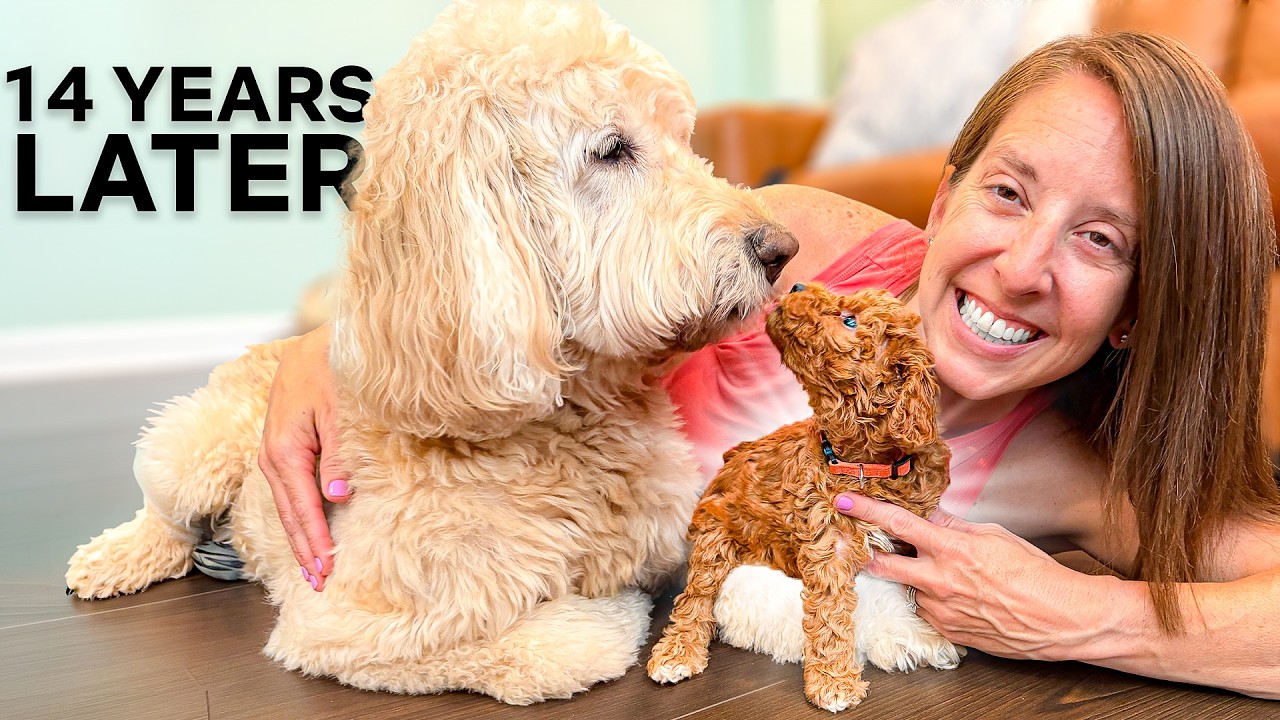
Standard Goldendoodles typically run 60 to 100 pounds. These are usually F1s — first generation crosses between a Golden Retriever and a Standard Poodle. We don't breed this size, but our program's matriarch, Bella, is a 73-pound standard. She's almost 14 years old, and she's the great-grandmother of nearly every puppy in our nursery.
Medium Goldendoodles fall in the 30 to 50 pound range. That's a wide window — our mediums are typically 30 to 40 pounds, though we do occasional larger medium litters that run 45 to 55 pounds for families who want that bigger dog feel without the full standard size. Mini Goldendoodles are 30 pounds and under. Most of ours land between 15 and 25 pounds. You'll sometimes hear the terms "micro" or "teacup" in the doodle world — we don't use that language. We keep it simple: 30 and under is a mini.
The Case for a Medium Goldendoodle
When we ask families why they wanted a medium, the answer is almost always some version of: "I grew up with a big dog."
They had a Golden Retriever or a Labrador or a Great Dane, and they love the feel of a substantial dog — one that takes up space on the couch, whose head rests on your lap when you're sitting down, who goes the distance on a hike without tapping out at mile two.
A medium Goldendoodle gives them that — without the shedding.
What life with a medium actually looks like
Our large medium, Honey, is 55 pounds. She's fluffy, she's warm, and she is relentlessly present. The girls love laying on the floor and cuddling with her. When you're sitting on the couch, her head rests right there. That's the thing families describe most — the physical comfort of a dog that size.
Mediums also have real endurance. Families who run or hike regularly tell us their medium can go four to six miles without slowing down. One of our alumni families ran a holiday 5K with their medium, Meritt, and he finished with a medal around his neck.
If you're active, love trails, paddle boarding, or just want a dog that can keep up — a medium is built for that.
Medium Goldendoodle quick facts
· Weight range: 30–60 lbs (our typical mediums are 30–40 lbs)
· Exercise: 45–60 minutes/day; can sustain 4–6 miles on a trail
· Best for: active families, those who grew up with large breeds, families with open floor plans and yards
· Coat: extra fluffy; low to non-shedding
The Case for a Mini Goldendoodle
Mini owners are a different kind of loyal.
We have a family in our alumni community called Life with Louie — they post almost every other day, just little moments. Louie running laps on the couch. Louie in a pile of leaves. It's nothing dramatic, and it's everything. That's what mini ownership looks like: a dog that fits into the fabric of daily life so completely that the moments just keep coming.
Who minis are actually perfect for
Three things kept coming up when we talked to our mini families about why they chose that size.
First: travel. Minis are easy to take everywhere — cars, RVs, planes. One of our alumni, Denver, has probably seen more of the United States than most people. Her family has an RV and they just go, and she goes with them. Minis fit under airplane seats. They don't require a cargo hold conversation.
Second: HOA and condo rules. This surprised us when we first started hearing it, but a meaningful number of families have weight or size restrictions in their building or neighborhood. A mini is often the only Goldendoodle that fits.
Third: first-time dog owners. This was the one that mattered most to us. Families who had never owned a dog before told us that a mini felt manageable in a way a larger dog didn't. The training commitment, the exercise requirement, the sheer physical presence of a 50-pound dog — it can feel like a lot when you're starting from zero. A mini gives first-time owners a version of the dog they love at a scale that feels like something they can actually do well.
Mini Goldendoodle quick facts
· Weight range: 15–30 lbs (ours are typically 15–25 lbs)
· Exercise: 20–25 minutes/day; good for 1–2 miles on a trail
· Best for: frequent travelers, HOA/condo households, first-time dog owners, families in smaller spaces
· Coat: low to non-shedding; easier to groom at smaller size
How to Actually Decide
Here are the four questions we walk families through when they're on the fence:
1. What does your living space look like? A 55-pound dog in a studio apartment is a different life than a 55-pound dog on two acres. Be honest about your square footage.
2. How active are you — honestly? Not aspirationally. A medium will want that exercise. If your real life is more walks-around-the-block than trail runs, a mini is a better match.
3. Do you have physical limitations? If bending down to pet a dog closer to the floor is hard, a medium — whose head finds you — is more practical than a mini you have to reach for.
4. Do you travel, and how? If planes are part of your life, a mini keeps that door open. If you drive everywhere and have room, a medium travels just as well in an SUV.
A Note on What We Breed
We breed both minis and mediums because we've seen both change families' lives in different ways. Neither is better. They're different tools for different lives. What we care about — regardless of size — is that the puppy leaving our home was raised the same way. Same health testing on the parents. Same enrichment program. Same whelping environment. Same attention in those first eight weeks.
Size is the last decision. How the dog was raised is the first one.
Ready to Learn More? If you're still deciding, the best next step is the application. It's five minutes, there's no commitment, and it starts a real conversation about which size — and which litter — makes sense for your family.
You can also watch the full video that inspired this post — it covers the same ground with puppies in the frame, which tends to make the decision a lot easier.